Showing posts with label Teaching Children Joy. Show all posts

Monday, May 14, 2012

Teaching children joy: Earth Part 1

 Teaching children joy:  Earth Part 1
"Growing cup"


 As part of our teaching children joy series we are moving on to joy of the earth.  With spring underway this is a wonderful time a year to focus on nature.  Today we made a visible "growing cup".  

We chose to use beans for our seeds since they grow rather fast.  Using a clear plastic cup, fill it with potting soil.  Now push your seeds down along the side of the cup so that the seed is still visible.  Water and set in a window.
 Fluttershy will be in charge of watering her plant everyday.  As the seed grows sends out roots we should be able to watch them grow. 

Friday, May 11, 2012

Teaching Children Joy: Spontaneous Delight

Teaching Children Joy: Spontaneous Delight

There are many ways to encourage and sanction a particular behavior; perhaps the best way of all is by participating in that particular behavior yourself.  (And perhaps the great benefit of preserving the natural, child-like joys in children is that we may recapture them ourselves)  (Teaching Children Joy Pg. 49)


 Some ways to find joy in being spontaneous are:

1. Get excited with children
- When they say "Oh look,"  you say, "Wow, yes."  Don't say, "Calm down, son," or "Not here, dear."  Let them be your teachers.  

2.  Help them relive spontaneous joy moments by remembering. 
  

3.  Do spontaneous things with them. 

-Instead of the regular routine at bedtime, take them our for ice cream.


4.  Surprise-oriented games

-Play hide and seek,  musical chairs,  etc.  

My girls love to play hide and seek.  They request at least 1 game right before bed.  It's really fun.  Especially when they are doing the counting and mom and dad are hiding.  

5.  Engage in the kid of play that produces exciting and unpredictable results.

- Blow bubble with a straw
- Finger paint
- play in the water with cups and funnels.

Today was a made bubble with straws and dish soap.  This was the first time I've tried this with Rarity.  She really did well with blowing through the straw.  After we played with the bubbles we tried a new game of ABC Bingo.

Fluttershy really enjoyed playing this new game and Rarity had fun just putting bingo markers on each square.  


I try to make sure we do something spontaneous every day to through some fun into the day and make it unique.  
Photobucket

Thursday, May 10, 2012

Teaching Children Joy: Body Part 10


Teaching Children Joy: Body Part 10
Teach simple songs
Teach simple songs and offer the children praise for singing. 

I thought using the video recorder would be fun so they could also watch themselves.

Always give  total encouragement and praise.  A negative word can ruin fragile physical confidence and delay or thwart the very physical joy you are trying to create and teach.  If the result is good, praise the result: "You did skip!"  "You sang that right on tune!"  If the result is not good, praise the attempt, the effort:  "What a good try!  Before long you'll do it!"  (Teaching children Joy pg. 63)


Wednesday, May 9, 2012

Teaching Children Joy: Body Part 9

 Teaching Children Joy: Body Part 9
Learning skills:  Balance

 Provide balancing toys, such as swing sets and tumbling mats.  
 (Teaching children Joy pg. 63)

Since we don't have a swing set we made our own balancing obstacle coarse with painting tape.  They tried walking, jumping, tumbling, and walking backwards are out paths.
 Activities they girls chose to do on their path was walking, hopping, walking backwards, and tumbling.

Monday, May 7, 2012

Teaching Children Joy: Body Part 8

 Teaching Children Joy: Body Part 8
Use and develop skills

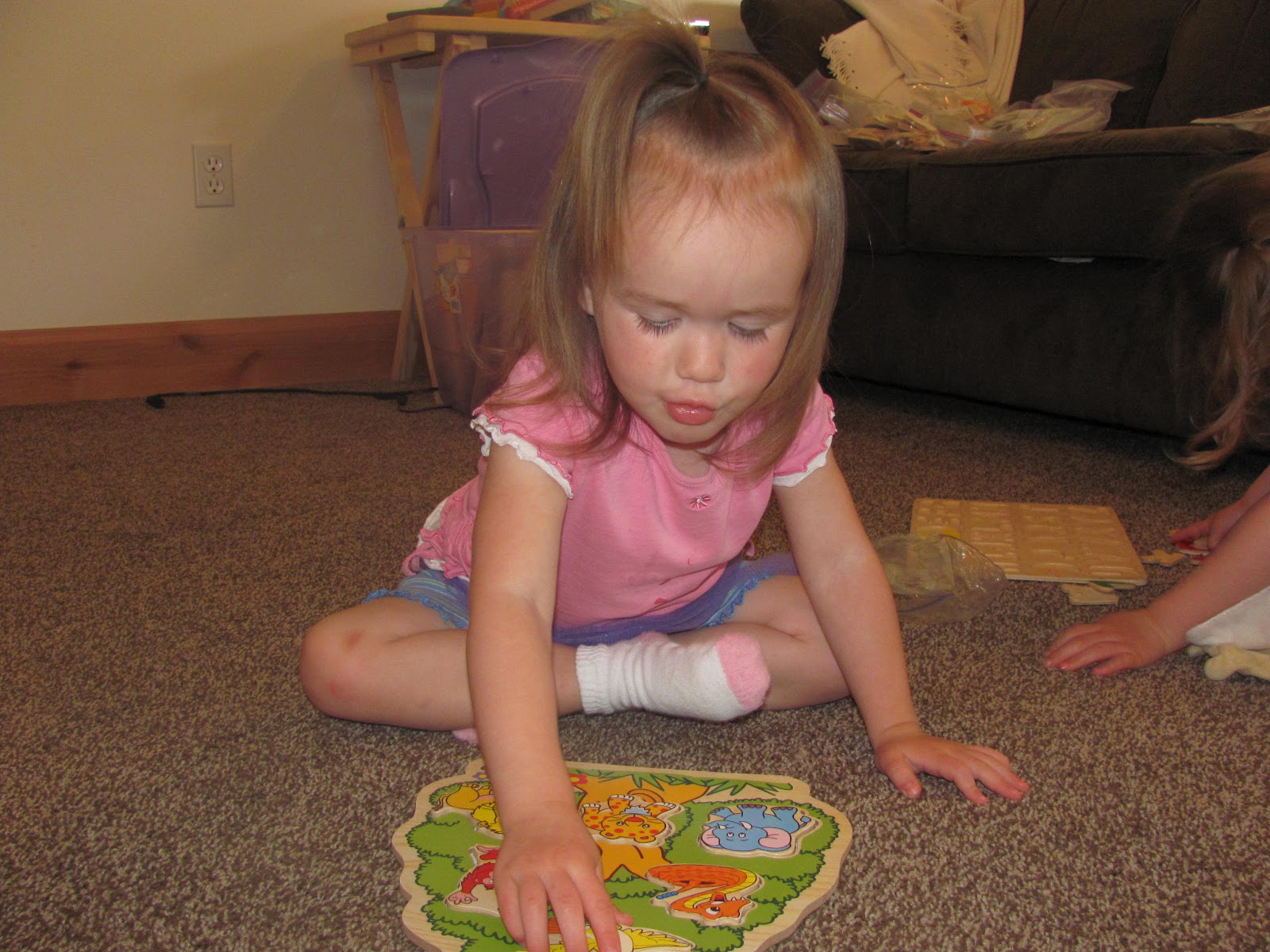
Provide small,manipulative toys-  Things that fit together and that develop hand-to-eye coordination. 

For our activity today we chose to do various types of puzzles.  Puzzles utilize so many skills.  

 
Puzzles are great for helping young brain develop and grow. That’s because the brain looks for patterns in our world — and puzzles are a true patterning activity. 


Patterning is also the foundation of reading, math and logic skills. So when your child does puzzles, they are doing one of the best brain building exercises for developing their reading, math and logic skills. 


They also develop problem solving skillsand individual success and achievement. That is why they like to do puzzles over and over again! (Maldonado, Nancy S., “Puzzles: A Pathetically Neglected, Commonly Available Resource,” Young Children, May 1996.)  


I have to add that doing puzzles teaches patience. Something my kids lack at times


 The best part of doing a puzzle is watching my kids face when the put the last piece in.  The sheer look of delight with their accomplishments can't be beat.